

SCRAP METAL LEGENDS
Where Legendary Sculptures Come to Life
Tap or click play button to listen to the legend.

Mixed Metal
120” Tall x 112” Wide x 102” Long
400 Pounds
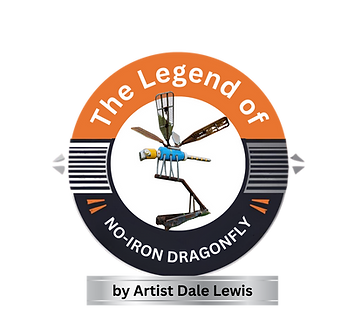
Artist Fun Fact: No-Iron Dragonfly was inspired by four ironing boards that looked like wings to me. Ironically, there is no clothes iron in this sculpture, hence the name “No-Iron.”
The Legend of No-Iron Dragonfly
In a forgotten corner of an old industrial yard, where rusted machines whispered stories of their working days, a sculptor once gathered the remnants of labor’s past. Bent pipes, broken hinges, and the laced frames of discarded ironing boards lay scattered like the bones of a bygone age. From this graveyard of metal, the sculptor envisioned something that could rise above the weight of toil—a creature of lightness and transformation.
Piece by piece, the sculptor welded the fragments together. The ironing boards became wings—broad, perforated, and shimmering with the memory of heat and steam. The body was cobbled together with colored tanks and cylinders, the tail from a tail pipe and eyes from bowls. When the final spark cooled, the figure stood ten feet tall, its wings outstretched as if ready to take flight. It was named No-Iron Dragonfly, a title both playful and profound. For though its wings were born from the tools of pressing and smoothing, not a single clothes iron was used in its making.
The townspeople who first saw it spoke of irony and liberation. They said the dragonfly carried the spirit of freedom from endless chores, from the weight of perfection. It reminded them that beauty could emerge from what was once cast aside, that even the remnants of labor could be reborn into something that soared. Children would run beneath its wings, tracing the holes in the metal where steam once escaped, imagining the hiss of transformation.
Over time, stories grew around the sculpture. Some claimed that just before dawn, No-Iron Dragonfly shimmered with a faint blue glow, as if remembering the fires that forged it. Others said that when the wind passed through its wings, it sang—a soft metallic hum that carried the promise of renewal. Travelers began to leave small offerings at its base: broken buttons, bent nails, and scraps of fabric, tokens of their own discarded burdens.
The legend came to symbolize more than art. It became a testament to adaptability and realization—the idea that transformation is not about erasing the past but reshaping it.
And so, No-Iron Dragonfly remains—wings wide, gaze lifted—forever poised between the weight of what was and the flight of what could be.

Scrap Metal Legends is an interactive traveling exhibit by artist Dale Lewis.
To learn how you can host this exhibit in 2026, contact:
Mecca Page
email FineArtRep4DaleLewis@gmail.com or
call 651-202-7370